|
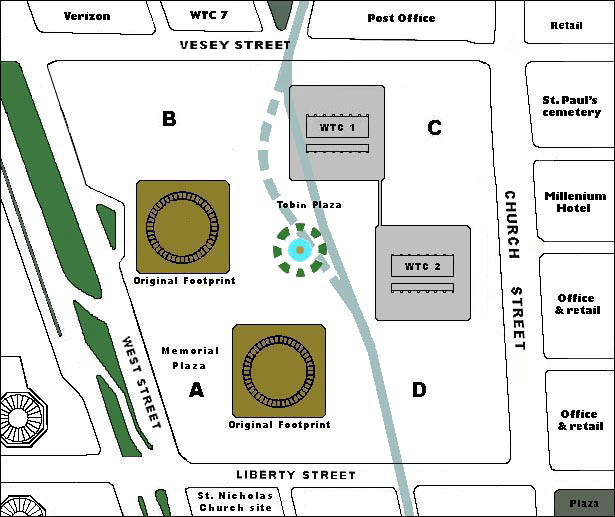
Fig. 7. This diagram is identical to fig. 5 except WTC 1 has been shifted 20 feet east to possibly better accommodate 3 or 4 skybridges and the No. 1 subway line. A lower skybridge (60 ft?) might also serve as a wing to reduce ground winds. It might be possible to also connect WTC1 and WTC7 with a lower skybridge. The visual blocking effect of the original tower alignment is about the same as fig. 5. If necessary WTC 1 (and WTC 2) could be shifted even farther east to save the relatively minor cost of modifying the already excavated No. 1 subway. Elevator orientation is complicated and would be modified to accommodate foot traffic, skybridge access, security, and views thru the site (see original WTC elevator plan). Click for a possible skybridge design (smoke doors, streamlining, and wing effect not shown).
|
|
|
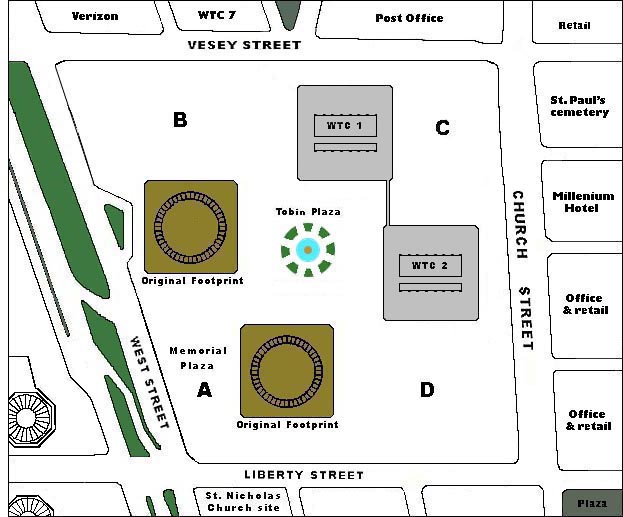
Fig. 8. Modification of the No. 1 subway. The dashed line is ~600 feet of new track. The south curve at D could be improved with more track. Note Fig. 5 requires slightly more curvature in the new track. Service would not be interrupted.
Click to go to the main site plan page. The Libeskind plan: The Freedom Tower (foundation under construction, same footprint as WTC1) and Fulton Street will be crowded into the northwest corner of the site at area B. Fulton Street will detract from the north memorial, and the fortress-like Freedom Tower will be out of place and inappropriate near the memorial. The Freedom Tower would be the tallest building in New York and a landmark structure; private industry would never build this special building at this poorly chosen commercial location; WTC 2 is the preferable location. The following excerpt from the NY Times shows the process which selected the Freedom Tower and its location: A few days after Mr. Libeskind was "anointed," as Mr. Silverstein put it, the men got together. In Mr. Silverstein's conference room, Nina Libeskind made it clear that her husband would be designing the 1776 building, as it was then known. "I looked at her in absolute shock and said, 'But he's never designed a high-rise in his life,' " Mr. Silverstein recalled. "I said, 'Tell me something. If you were needing neurosurgery, would you go to a general practitioner who has never done any kind of operating in his life?' She said, 'Daniel is a quick learner.' " Mr. Silverstein started picking apart Mr. Libeskind's master plan. He objected first to the location of the Freedom Tower at the northwest corner of the site, where it would be farthest from the transportation hub and, complicating construction, above the train tracks. But Mr. Silverstein lost that battle, and the next: "I said to Larry," Mr. Childs recalled, " 'If the governor won't move the tower, ask him if he would build it last. Then you'll have more of a market, the train station will be done and the slurry wall fixed.' But the governor said: 'No. I want to build it first. I want to build it there. And I want to build it quickly.' " |